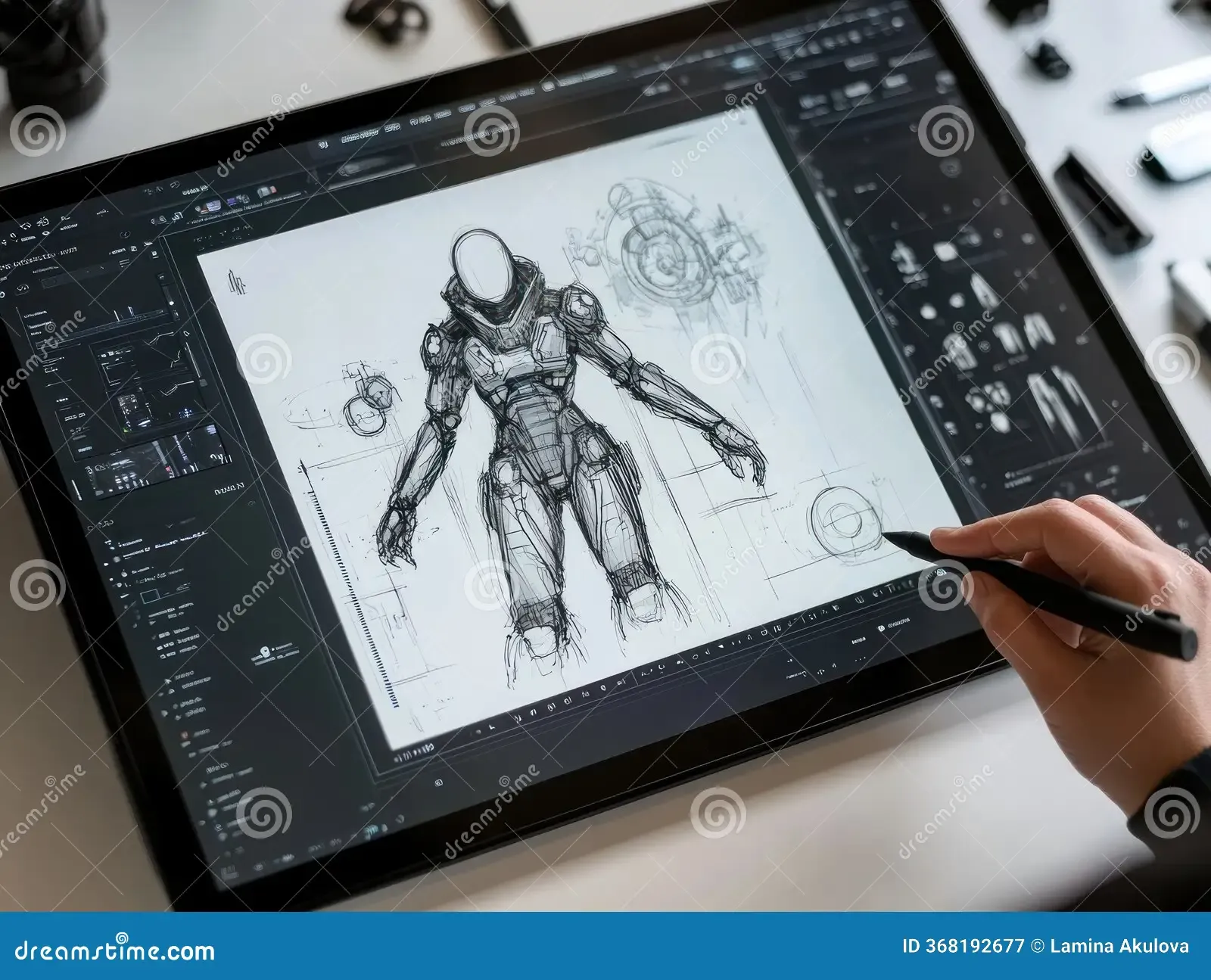
AI-assisted drawing concepts are fundamentally changing the way we approach a blank canvas, turning the once-daunting experience of a white screen into a collaborative dialogue between human intuition and algorithmic power. I remember the first time I sat down with a digital tablet and a primitive AI plug-in. I felt a strange mix of skepticism and wonder. For years, I had labored over anatomical proportions and the perfect fall of light, fearing that technology might eventually render those hard-earned skills obsolete.
However, as I began to integrate these new workflows, I realized that the technology wasn’t there to replace my hand but to act as a highly sophisticated assistant that could handle the heavy lifting of technical iteration. It felt less like a machine taking over and more like having a tireless intern who could offer a thousand different perspectives on a single charcoal sketch. This shift in mindset is where the true power of modern digital art resides today.
When we discuss the current landscape of digital creativity, we are seeing a move away from “prompting” toward a much more nuanced form of co-creation. The early days of simply typing a few words into a box and hoping for the best are fading. Now, professional artists are looking for tools that respect their original lines while providing the speed and flexibility that only machine learning can offer in a fast-paced commercial environment.
Exploring the Core of AI-assisted drawing concepts
To understand why this is such a seismic shift, we have to look at the specific mechanisms that make these tools work. At the heart of most modern software are neural networks that have been trained to understand the relationship between shapes, colors, and textures. When an artist uses a sketch-to-image feature, the AI isn’t just “finding” a photo to match; it is interpreting the artist’s intent based on millions of visual parameters.
This interpretation is what allows for the most exciting applications in character design and environment art. An illustrator can now provide a very rough, almost stick-figure-like scribble of a dragon, and the software will understand the weight of the wings and the texture of the scales. The artist remains the director, choosing the composition and the “soul” of the piece, while the AI provides the refined rendering that would traditionally take dozens of hours.
Furthermore, these systems are becoming increasingly adept at understanding “ControlNets,” which are essentially structural guides that allow the artist to maintain total control over the pose and the architecture of the drawing. This means that if you want a character to point their finger at a specific angle, you don’t have to fight the algorithm. You simply draw the line, and the AI fills in the realistic skin tones and clothing folds around it.
The Evolution of the Digital Brush
It is helpful to view this transition as part of a long historical arc of artistic tools. Centuries ago, the introduction of the camera lucida and the camera obscura allowed painters to achieve a level of perspective that seemed magical at the time. Later, the invention of oil paint in tubes allowed artists to leave the studio and paint in the open air, giving birth to Impressionism. Each of these was a technological leap that changed the definition of “art.”
In the same vein, the current era of digital tools is simply the next step in that evolution. We are moving toward a world where the technical barrier to entry is lower, but the value of a unique creative vision is higher than ever. When everyone has access to a tool that can render a sunset perfectly, the true artist is the one who chooses the right sunset to tell a specific emotional story.
I often speak with veteran illustrators who worry that the “struggle” of art is being lost. There is certainly something to be said for the discipline of learning how to draw a human hand through thousands of failed attempts. However, AI-assisted drawing concepts don’t remove the need for that knowledge; they simply change how we apply it. You still need to know what a hand looks like to know when the AI has gotten it wrong.
Real-World Applications: From Sketch to Masterpiece
One of the most practical uses of this technology is in the conceptual phase of a project. In the past, a concept artist for a video game might spend three days creating five different iterations of a futuristic city. Now, they can use AI to generate fifty variations in an hour, allowing them to spend the rest of their time hand-painting and refining the one specific idea that truly resonates with the creative director.
This speed of iteration is a game-changer for independent creators and small studios who don’t have the budget of a massive corporation. It democratizes the ability to create high-fidelity visuals, allowing a single person with a great story to produce a graphic novel or an indie game that looks like it was made by a team of twenty. It is an era of the “solo-preneur” artist, where the only limit is the scope of their imagination.
Think about the process of in-painting and out-painting, which are two of the most powerful tools in the modern artist’s belt. If you have a beautiful portrait but decide later that the character should be wearing a different hat, you no longer have to repaint the entire head. You simply mask the area, describe the new hat, and the AI integrates it seamlessly into the existing lighting and texture of the original drawing.
Navigating AI-assisted drawing concepts in Professional Workflows
For professionals, the focus is now on “latent space” exploration. This involves using the AI to find “happy accidents”—those unexpected visual combinations that a human mind might never have considered. I once worked on a piece where I was struggling to find the right color palette for a neon-lit rainstorm. I used an AI color-suggestion tool, and it provided a combination of lime green and deep burgundy that I initially hated.
But as I looked at it longer, I realized it created a sense of unease and tension that perfectly matched the narrative I was trying to convey. I would never have arrived at that choice through my traditional color theory training alone. This is the essence of the collaborative process: the AI provides the chaos, and the human provides the curation. It is a partnership that expands the boundaries of what we consider “human” creativity.
Trustworthiness in these tools is also a major talking point. Many artists are understandably concerned about the data used to train these models. The industry is responding by creating “ethical” AI models trained on licensed content or public domain images. This ensures that the professional artist can use these tools with a clear conscience, knowing that they are participating in a system that respects the intellectual property of their peers.
Balancing Technology and the Human Soul
The most common criticism of AI-generated work is that it can feel “hollow” or “too perfect.” There is a specific kind of digital “gloss” that often gives it away. This is where the human touch becomes indispensable. An artist knows how to introduce intentional imperfections—a slightly wobbly line, a bit of messy texture, or an asymmetrical feature—that make a character feel alive and relatable.
We are entering a phase where the “human-in-the-loop” is the most important part of the equation. Software companies are now building interfaces that allow for real-time, brush-stroke-by-brush-stroke interaction. You aren’t waiting for a progress bar to finish; you are painting with a brush that intelligently suggests shadows as you move your hand. It is a seamless integration that feels like an extension of your own nervous system.
Expertise in this field now requires a blend of traditional artistic knowledge and a deep understanding of software parameters. You need to know about lighting, anatomy, and composition to “steer” the AI toward a high-quality result. If you don’t understand the fundamentals, you won’t know how to fix the errors that the algorithm inevitably makes. The “pilot” of the brush is still the most valuable person in the room.
Technical Proficiency Meets Algorithmic Speed
If we look at the educational sector, we see a massive shift in how art is being taught. Universities are beginning to introduce classes on how to manage AI workflows alongside traditional life-drawing sessions. This holistic approach ensures that the next generation of artists is equipped with the tools of the future without losing the foundations of the past. It is about building a versatile skill set that can adapt to a rapidly changing market.
Many artists have found a new revenue stream by selling custom “brushes” and “models” that they have trained on their own specific style. This allows them to scale their creative output without sacrificing their unique artistic voice. It is a fascinating new business model where you aren’t just selling a single image; you are selling the “logic” of your aesthetic so that others can use it as a starting point for their own creations.
The concept of “Image-to-Image” transformation is also playing a huge role in the world of animation. By providing a keyframe and using AI to maintain the consistency of the characters across hundreds of subsequent frames, small animation teams can produce high-quality content that previously required a Disney-sized budget. This is opening the door for more diverse voices and stories to enter the world of film and television.
The Future of Creative Direction
As we look toward the next decade, the role of the “artist” may slowly transition into the role of the “curator” or “creative director.” When the technical execution becomes a solved problem, the value shifts entirely to the idea, the narrative, and the emotional resonance of the work. We will be judged not by how well we can render a chrome sphere, but by why we chose to put that sphere in the middle of a desert at midnight.
There is a growing community of creators who are using AI-assisted drawing concepts to explore “surrealist” and “impossible” art. Because the AI doesn’t have the same physical biases that we do, it can suggest architectural structures or biological forms that seem to defy the laws of gravity and evolution. Exploring these “latent spaces” provides a constant source of inspiration for architects, fashion designers, and concept artists looking for the next big thing.
We also have to consider the accessibility aspect of these tools. For individuals with physical disabilities who may not have the motor skills to hold a traditional brush for long periods, AI offers a way to express their visual ideas with incredible precision. It is a powerful tool for inclusivity, ensuring that the world of art is open to everyone, regardless of their physical limitations.
The dialogue between art and technology has always been a bit messy, filled with tension and fear. But if we look at the results—the incredible new worlds being built, the diverse stories being told, and the sheer speed of innovation—it is hard not to be excited. We are living in a time where the bridge between a thought and an image is shorter than it has ever been in human history.
For those of us who have spent our lives with a pencil in hand, this isn’t a replacement. It is an invitation to dream bigger. It is a call to move past the tedious technical hurdles that used to eat up our days and to focus on the things that truly matter: the story, the emotion, and the human connection. The brush of the future is here, and it is smarter than we ever imagined, but it still needs a human hand to guide it toward something truly beautiful.
As we continue to explore these digital frontiers, the most important thing is to remain curious. Don’t be afraid to break the tools, to push the algorithms to their limits, and to find the “soul” in the machine. Art has always been about the human experience, and no matter how many neurons a network has, it will always need us to tell it what it means to feel, to love, and to create. The canvas is waiting, and the possibilities are infinite.